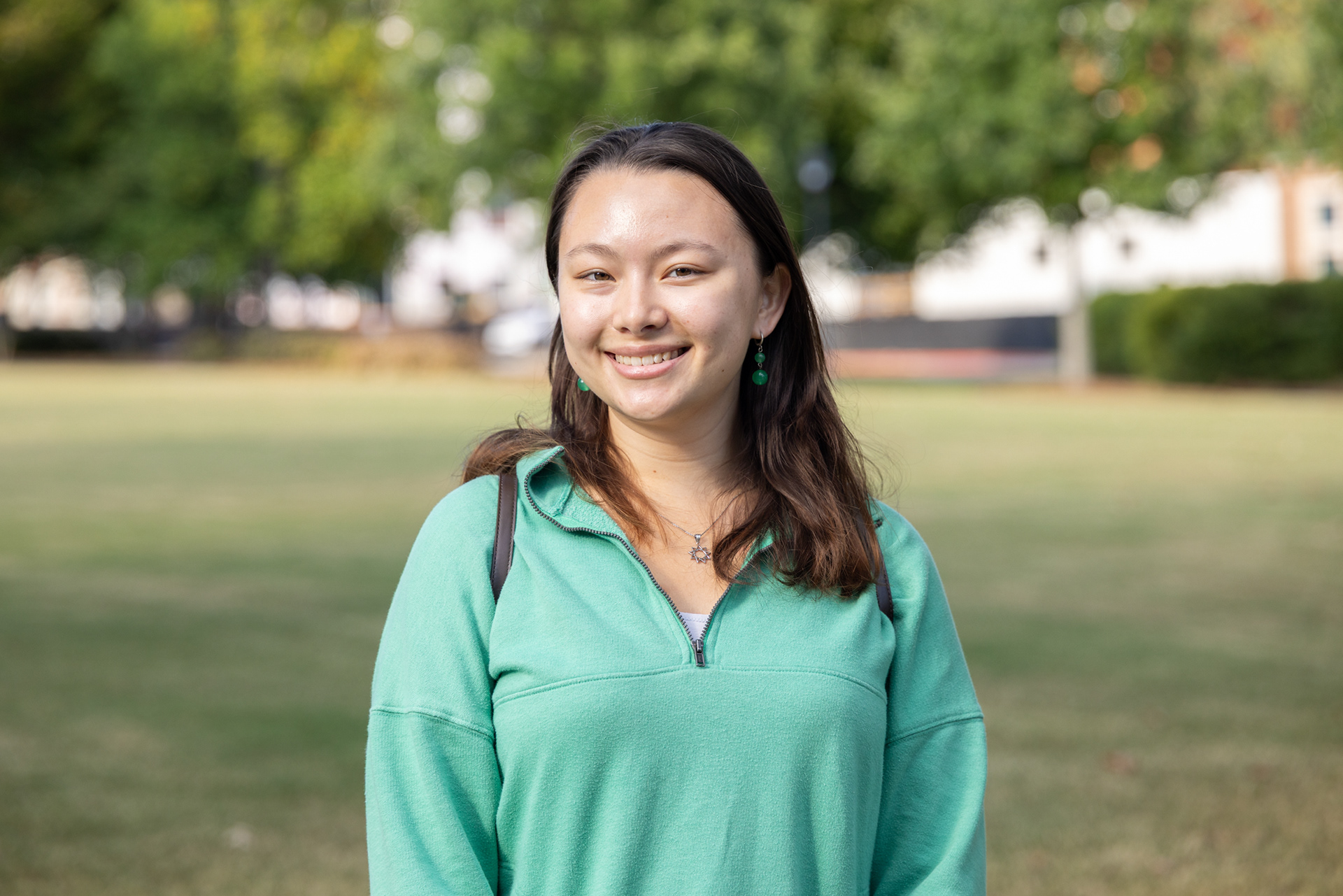
Sophia Hinson poses for a photo at the University of Georgia on Monday, Sept. 22, 2025. Hinson is a member of the Baha’i faith and has degrees in psychology and sociology from UGA. (Photo/Evan Frilingos)
By Evan Frilingos
Sophia Hinson is a recent University of Georgia graduate and a member of the Baha’i faith, a world religion that believes in the oneness and interconnectedness of humanity and its religions. There are around five million Baha’is in the world, according to Baha’i World News Service.
Q: What are some of the key tenets of Baha’i?
A: Unity in diversity is definitely a core pillar, if not, like, the top of the pyramid for the Baha'i faith. I believe that there's so much that's unique about the Baha'i faith, because it's designed for a very unique time in human history. When the Báb – the first of the Baha’i prophets – declared his mission, the first telegram in the United States was being sent. That's when so many technological advances started, and I believe that the Baha'i faith provides a lot of guidance in material challenges that humanity just has not had to face in the past.
Q: Why does Baha’i have so few members despite being one of the most geographically widespread religions?
A: Because the Baha’i faith is so young; it only originated in, like, the mid 1800s, so it only has about 200 years of history. Baha’is are strictly warned against proselytizing. We're not supposed to try and push to convert people. We believe that if we are welcoming and if people are receptive to Bahá’u’lláh’s teachings, then they will be attracted to the Baha'i faith themselves.
Q: When does that attraction lead to a need for conversion?
A: I think that depends on the individual. You know, if they feel that their life as a Christian is something that benefits themselves and the people around them and can lead them towards a more spiritually flourishing life, then there's no need to deviate from that. I do know of a lot of people who have declared themselves as Baha'i after having lived a life according to another religion. From a Baha'i perspective, you're not turning your back on the religion that you believed in previously because it's seen as more of a continuation of your religious purpose.
Q: What is Baha’i doing to push back against the political, social and religious division and polarization in Athens and beyond?
A: There aren't many Baha’is here, but what comes first to mind is just different community events that have been happening. One of the local community members, Nasrin, she'll host things like a tea and talk at her home where there's a different activity every time. We've written haikus together, last time was a dance class, and before then it was, like, a question that you pair up with someone to talk about. So just things like that to help bring people closer together, designed to show you that we're more similar than we are different. The Baha'i faith teaches that any divisiveness that stems from religion doesn't come from the religion itself, but rather the way it's adapted to humanity or the way somebody has presented it, if that makes sense. The Baha'i community is just trying to remove these misperceived barriers.
Comments trimmed for length and clarity.
Why I wrote this story
I am on the religion beat, and I wanted to do a story on a religion that has a student and local following but doesn't receive as much coverage as other religions. Baha'i is the most widespread world religion but is unknown to many in Athens, so the story had unusualness and proximity as top newsworthy factors.